Mortgage After Bankruptcy or Consumer Proposal in Quebec: Complete Guide
Securing a mortgage after bankruptcy or a consumer proposal in Quebec is entirely possible. Learn the essential timelines, credit re-establishment strategies, and lender requirements to get approved.
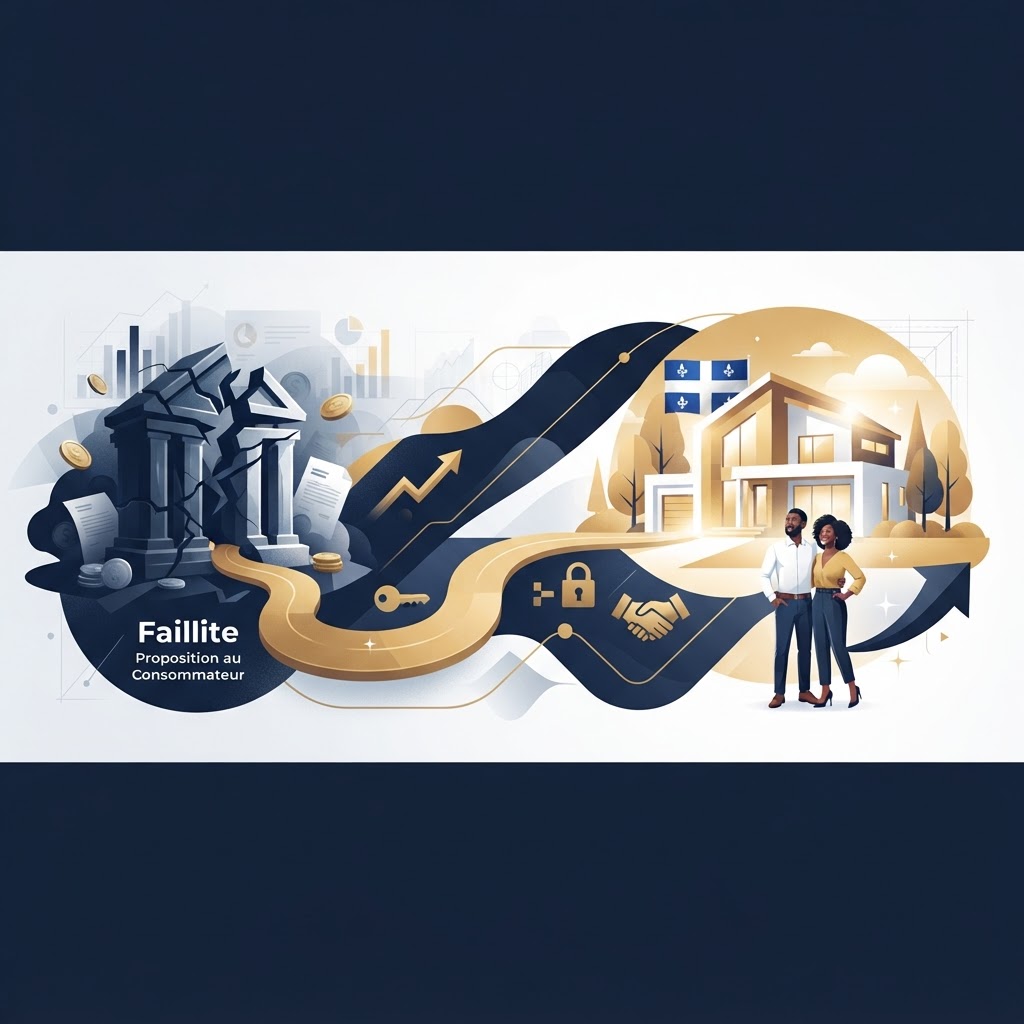
Mortgage After Bankruptcy or Consumer Proposal in Quebec: Complete Guide
Filing for personal insolvency can feel like closing the door on real estate dreams, but obtaining a mortgage after bankruptcy or consumer proposal is a realistic and achievable goal in Quebec. Thousands of Canadians rebuild their financial lives every year and successfully buy homes after completing debt restructuring programs.
A mortgage after bankruptcy or consumer proposal refers to home financing secured after a borrower has received a formal legal discharge from personal bankruptcy or a Certificate of Full Performance on a consumer proposal under the Canadian Bankruptcy and Insolvency Act (BIA). While traditional banks impose waiting periods and credit rehabilitation rules, specialized mortgage channels exist at every stage of financial recovery.
Whether you plan a future property purchase or want to structure your path forward, understanding lender expectations and provincial guidelines will help you obtain competitive home financing.
Understanding the Basics: Bankruptcy vs. Consumer Proposal
Both personal bankruptcy and consumer proposals provide legal debt relief under federal law, but their impact on your credit file and mortgage approval timeline differs significantly.
| Feature | Personal Bankruptcy | Consumer Proposal | | :--- | :--- | :--- | | Credit Bureau Rating | R9 (worst possible rating) | R7 (settlement under statutory plan) | | Equifax Purge Timeline | 6 years post-discharge (1st filing) | 3 years post-completion (or 6 years from filing date) | | TransUnion Purge Timeline | 6–7 years post-discharge | 3 years post-completion | | Secured Debts (Mortgages) | Retained if payments stay current | Retained if payments stay current | | Typical Waiting Period (A-Lender)| 2 years post-discharge | 2 years post-completion |
During insolvency proceedings, your primary residence is often protected if home equity remains within legal thresholds or if secured mortgage obligations are serviced on time. When your restructuring ends, focus shifts entirely to rebuilding creditworthiness.
Timeline for Getting a Mortgage After Bankruptcy or Consumer Proposal
Approval timelines depend primarily on the category of mortgage lender you approach in Quebec:
1. Traditional A-Lenders (Chartered Banks & Desjardins)
Prime lenders typically follow mortgage default insurance rules set by the Canada Mortgage and Housing Corporation (CMHC) and private insurers like Sagen and Canada Guaranty:
- Waiting Period: A minimum of 2 full years must elapse following your discharge date (bankruptcy) or full payout date (consumer proposal).
- Down Payment: Down payments start at 5% for properties under $500,000 (minimum 5% on the first $500k and 10% on the portion above).
- Credit History: You must establish an active, clean post-insolvency credit track record.
2. Alternative B-Lenders (Trust Companies & Credit Unions)
B-lenders evaluate applications based on common-sense underwriting rather than rigid credit score cutoffs:
- Waiting Period: Approvals are possible 1 day to 1 year after discharge or completion.
- Down Payment: Minimum 20% down payment is required because these mortgages are uninsured.
- Rates & Fees: Interest rates sit approximately 1.5% to 3.5% higher than prime rates, often accompanied by a 1% lender fee.
3. Private Lenders
If your proposal remains active or you require financing immediately post-discharge, private mortgage lenders provide interim bridge funding:
- Waiting Period: None (approvals occur during an open proposal or right after bankruptcy).
- Down Payment: Minimum 20% to 25% equity or cash down payment.
- Strategy: Private mortgages serve as short-term solutions (1 to 2-year terms) while credit rehabilitation continues, followed by refinancing into an A- or B-lender.
The 2+2+2 Rule: The Blueprint for Prime Approval
Mortgage underwriters rely heavily on the industry standard 2+2+2 rule to determine if an applicant is ready for prime interest rates:
- 2 Years Discharged: Two complete years have passed since your official Certificate of Discharge or Certificate of Full Performance was issued.
- 2 Re-Established Credit Facilities: You maintain at least two separate active credit lines (such as a secured credit card and a small installment loan).
- 2 Years of Clean History with $2,000+ Limits: Both trade lines have carried a minimum $2,000 credit limit for at least two consecutive years with zero missed or late payments.
   [Certificate of Discharge]
               │
               ▼
   Open 2 Credit Lines ($2,000+ limits)
               │
               ▼
   Maintain 24 Months of Flawless Payments
               │
               ▼
   [Prime Mortgage Approval Eligibility]
Step-by-Step Guide to Rebuilding Your Credit for a Mortgage
Step 1: Secure Your Discharge Documents
Lenders will not process an application without proof of completion. Keep original copies of:
- Certificate of Discharge (for bankruptcy) or Certificate of Full Performance (for consumer proposals).
- The complete list of creditors included in the restructuring.
Step 2: Audit Your Equifax and TransUnion Reports
Former creditors frequently fail to update credit bureaus post-discharge, leaving accounts erroneously marked as "in collection" or "written off."
- Request copies of your credit files directly from Equifax and TransUnion.
- File formal disputes for any pre-filing debts that do not display an R7/R9 status or zero balance.
- Verify that public records correctly reflect your legal discharge.
Step 3: Establish Secured Credit Cards
Apply for a secured credit card backed by a cash deposit immediately after receiving discharge paperwork. Keep overall credit utilization below 30% of your maximum limit, and pay statement balances in full every month to accelerate score recovery.
Step 4: Accumulate a Solid Down Payment
Saving a larger down payment reduces lender risk. A down payment of 20% or more bypasses mortgage default insurance requirements, unlocking B-lender options if your credit score has not yet crossed the 650 threshold.
Mortgage Payment Scenario: Alternative vs. Prime Rates
To illustrate the financial impact of financing a home purchase post-insolvency, let us evaluate an actual Quebec market scenario.
Note: All figures below are realistic estimates for comparison purposes. Rates reflect prevailing market conditions as of March 2025.
- Purchase Price: $400,000
- Down Payment: $80,000 (20% down payment, uninsurable transaction)
- Mortgage Loan Amount: $320,000
- Amortization Period: 25 years
- Term Duration: 3-year fixed term
Scenario A: Alternative B-Lender (1 Year After Completion)
- Interest Rate: 6.89% (as of March 2025)
- Monthly Principal & Interest Payment: $2,220.14
- Annual Interest Paid (Year 1 Estimate): ~$21,800
- Note: A 1% lender fee ($3,200) typically applies at closing.
Scenario B: Traditional A-Lender (2+ Years After Completion with Re-Established Credit)
- Interest Rate: 4.79% (as of March 2025)
- Monthly Principal & Interest Payment: $1,822.46
- Annual Interest Paid (Year 1 Estimate): ~$15,150
- Note: No lender fees apply at closing.
Key Takeaway: Financing via an alternative lender costs approximately $397.68 more per month ($4,772 annually) in this comparison. However, selecting an alternative lender allows you to enter the real estate market earlier, build equity, and execute a standard mortgage renewal or refinance back to a prime lender once credit files meet standard guidelines.
Qualifying Criteria and Debt Service Ratios in Quebec
When applying for a mortgage after bankruptcy or consumer proposal, Quebec lenders examine financial stability through strict debt service limits established by financial regulators:
- Gross Debt Service (GDS) Ratio: Housing costs (mortgage principal, interest, municipal and school taxes, plus 50% of condo fees) must not exceed 32% to 39% of verifiable gross monthly income.
- Total Debt Service (TDS) Ratio: Total monthly debt obligations (housing expenses plus credit cards, personal loans, and auto financing) must remain below 40% to 44% of verifiable gross income.
- Employment Stability: Lenders generally seek a minimum of 12 to 24 months of continuous, stable employment with verified T4 slips and Notices of Assessment (NOAs) from the Canada Revenue Agency and Revenu Québec.
For self-employed Quebecers recovering from insolvency, specialized bank statement programs allow qualification based on verifiable enterprise cash flow rather than traditional line 15000 taxable net income.
Expert Mortgage Broker Support
Navigating Quebec mortgage guidelines after an insolvency requires strategic timing, accurate file presentation, and access to institutional lenders who evaluate the story behind your numbers. Applying randomly to big banks can trigger hard credit inquiries that lower your score without securing an approval.
Read more about homeownership strategies on our blog, or review the background of our brokerage team on our about us page. When you are ready to explore your options, contact our licensed mortgage advisors for a confidential, judgment-free assessment of your borrowing capacity.
Frequently Asked Questions
Can I buy a home while still inside an active consumer proposal?
Yes, but traditional A-lenders will not approve the loan. You will need an alternative B-lender or private mortgage lender, along with a minimum 20% down payment. In most cases, lenders require the remaining consumer proposal balance to be paid in full from personal funds or mortgage proceeds at closing.
Can my current Quebec mortgage be renewed if I file for bankruptcy?
If you declare personal bankruptcy but keep your existing mortgage payments fully up to date, your existing lender will typically offer an automatic mortgage renewal upon term expiration. Problems only arise if you default on mortgage payments or attempt to switch lenders while bankruptcy remains on your record.
How soon does a consumer proposal disappear from my credit report?
In Quebec, consumer proposals are purged from Equifax and TransUnion reports 3 years after all payments are completed, or 6 years from the initial filing date (whichever comes first).
Do private mortgage lenders inspect my credit score?
Private lenders focus primarily on property equity, marketable location, and overall loan-to-value (LTV) ratio rather than credit ratings. While credit files are reviewed, approval does not depend on minimum credit score thresholds.
Will I need a co-signer to get approved?
Adding a creditworthy co-signer or guarantor with a strong credit profile and verifiable income can significantly improve approval chances with traditional A-lenders if you have not met the complete two-year rehabilitation benchmark.
Mots-clés :