How to Qualify for a Mortgage in Quebec: The Ultimate 2026 Guide
Qualifying for a mortgage in Quebec involves meeting strict criteria regarding income, credit history, and debt ratios. This guide explains the 2026 standards for Canadian borrowers.
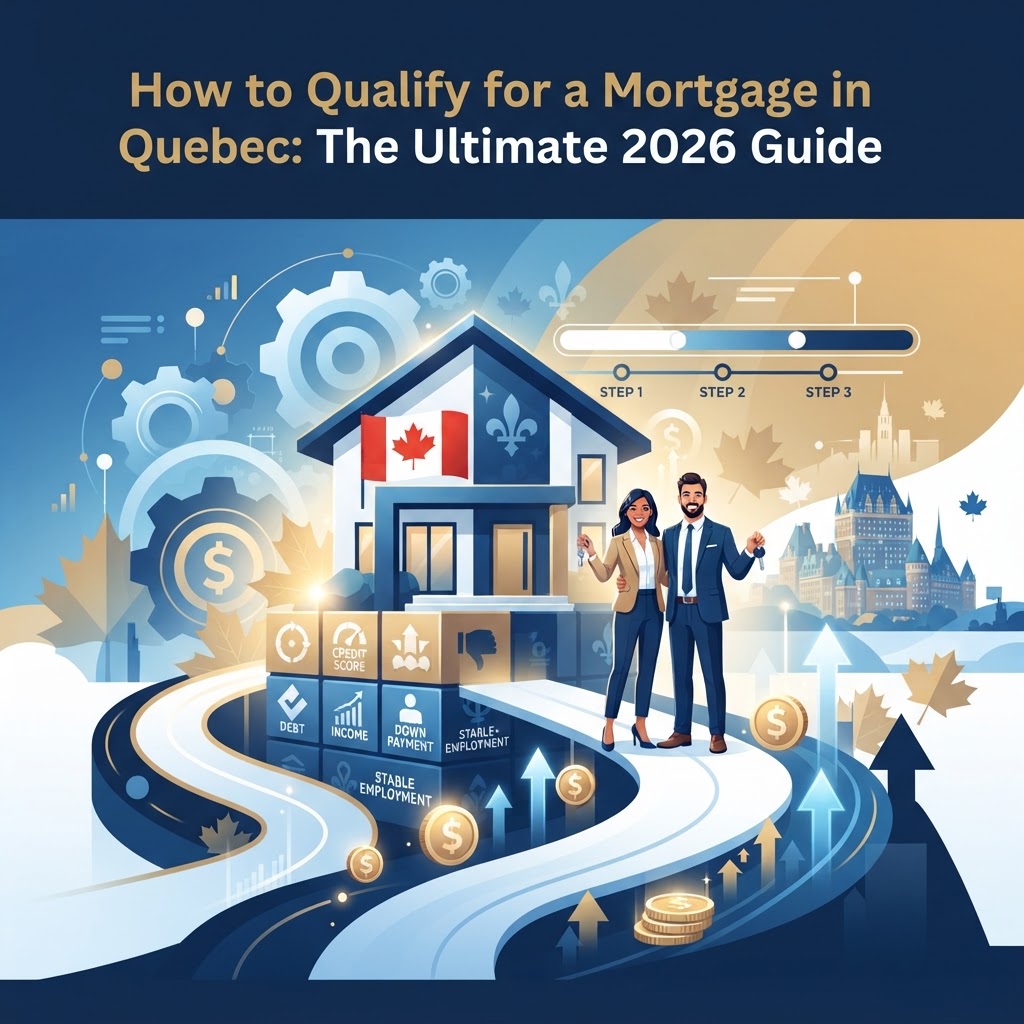
How to Qualify for a Mortgage in Quebec: The Ultimate 2026 Guide
Understanding how to qualify for a mortgage is the most critical step for any aspiring homeowner in Quebec. Whether you are looking at a condo in Montreal or a single-family home in Gatineau, the process of securing financing involves more than just having a steady job. Lenders in Canada follow strict guidelines set by federal and provincial regulators to ensure that borrowers can maintain their payments even if economic conditions change.
In this comprehensive guide, we will break down the essential requirements for mortgage qualification in 2026, from the dreaded stress test to the specific documentation required by Quebec notaries. By the end of this article, you will have a clear roadmap for purchasing a property with confidence.
What Does it Mean to Qualify for a Mortgage?
To qualify for a mortgage means to meet a lender's specific criteria regarding your ability to repay a large loan over a long period. In Canada, this is not a subjective decision; it is based on a mathematical formula that considers your income, existing debts, credit history, and the value of the property you intend to buy. Lenders use these factors to determine your "borrowing capacity," which is the maximum amount they are willing to lend you.
How to Qualify for a Mortgage: The Core Requirements
To successfully navigate the application process, you must satisfy four primary pillars of qualification:
- Income Stability: You must prove you have a reliable source of income to cover monthly payments.
- Credit Worthiness: A high credit score demonstrates your history of managing debt responsibly.
- Down Payment: You must have the minimum required capital upfront.
- Debt Ratios: Your total debt obligations must stay within specific percentages of your gross income.
1. The Mortgage Stress Test: The 2026 Standard
Even if you find a lender offering a low interest rate, you must prove you can afford payments at a much higher "qualifying rate." This is known as the mortgage stress test. According to the Financial Consumer Agency of Canada, federally regulated lenders must qualify you at the higher of:
- Your contract interest rate plus 2%.
- The benchmark floor rate of 5.25%.
As of May 2026, with market rates hovering around 4.5%, most borrowers are being stress-tested at 6.5%. This ensures that if the Bank of Canada raises rates in the future, you won't default on your home.
2. Calculating Your Debt Ratios: GDS and TDS
Lenders use two specific ratios to decide how much you can afford. These are the Gross Debt Service (GDS) and Total Debt Service (TDS) ratios.
- Gross Debt Service (GDS): This measures the percentage of your gross monthly income that goes toward housing costs (Principal, Interest, Taxes, and Heating, or PITH). Generally, your GDS should not exceed 32% to 39%.
- Total Debt Service (TDS): This includes your housing costs plus all other monthly debt obligations, such as car loans, student loans, and credit card minimums. Your TDS should not exceed 40% to 44%.
If your ratios are too high, you may need to pay down existing debt or look for a less expensive property to qualify.
3. Credit Score Requirements for Quebec Borrowers
Your credit score is a numerical representation of your financial reliability. In Quebec, most A-lenders (major banks) prefer a credit score of at least 680. While it is possible to qualify with a score as low as 600, you may be relegated to B-lenders who charge higher interest rates. To maintain a healthy score, ensure you pay all bills on time and keep your credit utilization below 30% of your available limits.
4. Down Payment Rules and CMHC Insurance
In Canada, the minimum down payment depends on the purchase price of the home:
- $500,000 or less: 5% of the purchase price.
- $500,001 to $999,999: 5% on the first $500,000 and 10% on the portion above that.
- $1,000,000 or more: A flat 20% down payment is required.
If you put down less than 20%, you must purchase mortgage default insurance, often provided by the CMHC (Canada Mortgage and Housing Corporation). This insurance protects the lender, not you, and the premium is typically added to your total mortgage balance.
Essential Documentation for Quebec Borrowers
When you apply, you will need to provide a mountain of paperwork. Being organized can speed up your mortgage pre-approval Quebec process significantly. You will typically need:
- Proof of Income: Recent pay stubs and a letter of employment. If you are self-employed, you will need the last two years of Notices of Assessment (NOA) from both the CRA and Revenu Qu bec.
- Proof of Down Payment: Three months of bank statements showing the accumulation of funds. If the money is a gift, you will need a signed "gift letter."
- Property Details: The MLS listing and the municipal tax bill for the property you want to buy.
- Liability Information: Statements for all outstanding loans and credit cards.
Quebec-Specific Mortgage Considerations
Quebec has a unique legal and tax landscape that affects how you qualify for a mortgage.
The Role of the Notary
Unlike other provinces that use lawyers, Quebec transactions are handled by a Notary. The Notary is responsible for title searches and registering the mortgage with the Registre foncier. You must factor in notary fees (usually $1,500 to $2,500) when calculating your closing costs.
The Welcome Tax (Transfer Duties)
Every municipality in Quebec charges a land transfer tax, colloquially known as the "Taxe de Bienvenue." This is not included in your mortgage and must be paid in cash shortly after closing. Lenders will want to see that you have at least 1.5% of the purchase price set aside for closing costs, including this tax.
AMF Regulation
Mortgage brokers in Quebec are regulated by the Autorit des march s financiers (AMF). This ensures a high standard of ethics and professional conduct. Working with a licensed broker can help you navigate complex files, especially if you are nearing a mortgage renewal.
Calculation Example: What Can You Afford?
To illustrate how these factors come together, let's look at a typical scenario for a first-time buyer in Quebec.
Scenario Details:
- Home Price: $500,000
- Down Payment: $25,000 (5%)
- Mortgage Amount: $475,000 + $19,000 (CMHC Premium) = $494,000
- Interest Rate: 4.5% (Fixed)
- Term: 5-Year Fixed
- Amortization: 25 Years
- Date of Rate: May 20, 2026
Estimated Result: The monthly mortgage payment would be approximately $2,733.
Note: This result is an estimate. Actual payments may vary based on the specific lender, exact insurance premiums, and property tax adjustments. Always contact our experts for a personalized calculation.
Steps to Take if You Don't Qualify for a Mortgage Immediately
If you find that you don't currently meet the criteria, don't panic. There are several ways to improve your profile:
- Reduce Your Debt-to-Income Ratio: Focus on paying off high-interest credit cards or car loans to lower your TDS ratio.
- Increase Your Down Payment: Saving even an extra 2-3% can significantly lower your monthly obligations and help you pass the stress test.
- Find a Co-signer: A family member with strong credit and income can be added to the application to help you qualify.
- Improve Your Credit Score: Ensure there are no errors on your Equifax or TransUnion reports and maintain a perfect payment history for at least 12 months.
Conclusion
Learning how to qualify for a mortgage is a journey of financial preparation. By understanding the stress test, managing your debt ratios, and saving for a sufficient down payment, you place yourself in a position of strength. The Quebec market remains competitive, but with the right documentation and a clear understanding of provincial costs like the Welcome Tax, your dream of homeownership is well within reach.
Ready to take the next step? Whether you are buying your first home or looking for a mortgage renewal, our team is here to guide you through every calculation and requirement.
Mots-clés :